
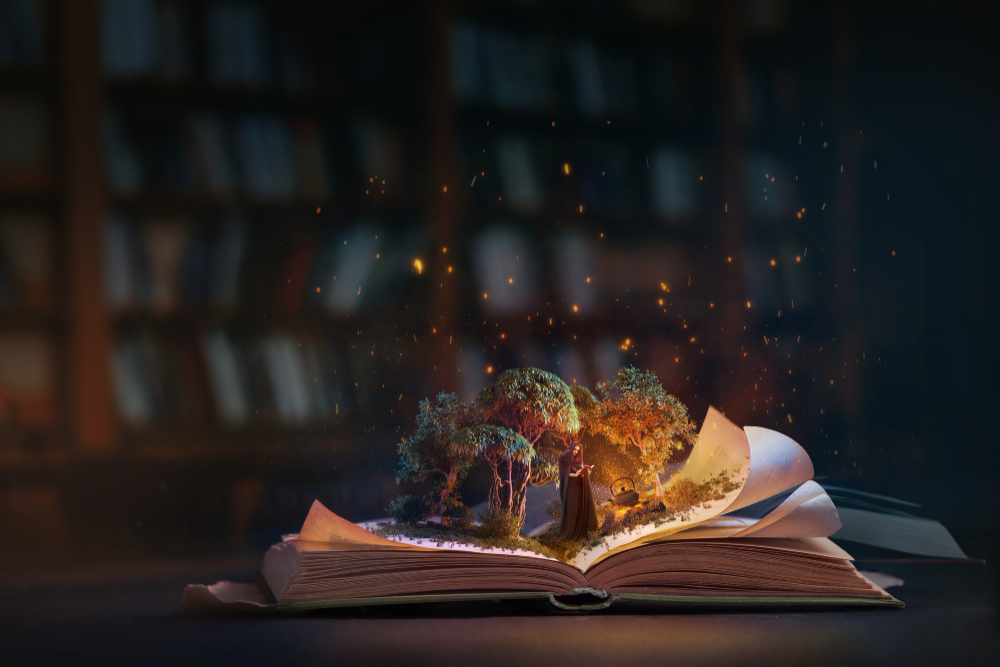
While movies and games give a child the “finished product,” a storybook is basically a “DIY Imagination Kit.” Since the child can’t see every detail or hear every sound, their brain is forced to work overtime to fill in the gaps.
Here is how storybooks act as a gym for a child’s creativity:
1. Visual Gap-Filling (The “Internal Cinema”)
When a child hears the sentence, “The dragon flew over the purple mountains,” their brain has to build that scene. Unlike a movie where the dragon is already designed, the child has to decide:
- How many wings does it have?
- Is it scaly or fuzzy?
- What shade of purple are the mountains? The result: They aren’t just consuming art; they are mentally illustrating it in real-time.
2. Empathy & “Perspective Shifting”
Creativity is the ability to see the world from a different angle. Books allow children to “body swap” with characters who are nothing like them—a talking cat, a lonely giant, or a kid in a different country.
- By practicing empathy, they learn to ask “What if?”
- “What if I were small enough to live in a teapot?” This “What if” mindset is the foundation of all creative problem-solving.
3. Vocabulary as a “Color Palette”
You can’t paint a masterpiece with only three colors, and you can’t think of complex ideas with only a few words.
- Storybooks introduce “sparkle words” (like shimmering, colossal, or mysterious).
- The more specific words a child knows, the more specific their thoughts become. Instead of just “a big house,” they can imagine a “crumbling mansion,” which leads to much more creative storytelling in their own play.
4. Logic-Defying “Safe Spaces”
In the real world, gravity exists and dogs don’t talk. In a storybook, the rules of physics are optional.
- Reading about a house made of clouds or a forest where it rains lemon drops teaches the brain that possibilities are infinite. *
- This breaks down “functional fixedness”—the habit of only seeing objects for their intended use (e.g., a box isn’t just a box; it’s a spaceship).